 Doctor's Column
 Staff Blog
 campaign
 News
News





2023.09.01
double-entry burial
About Blepharoplasty and Elevator Technique

Dr Kuroda
In this issue, we continue with the implantation method.
Since some knowledge of anatomy is necessary to properly understand the implantation process, we recommend that those who have not read the previous column read through it first before reading this one.
【https://ro-clinic.com/doctors_column/9418/】
CONTENTS
Previous Review
The implantation methods can be roughly classified into the "eyelid plate method" or the "raising muscle method.
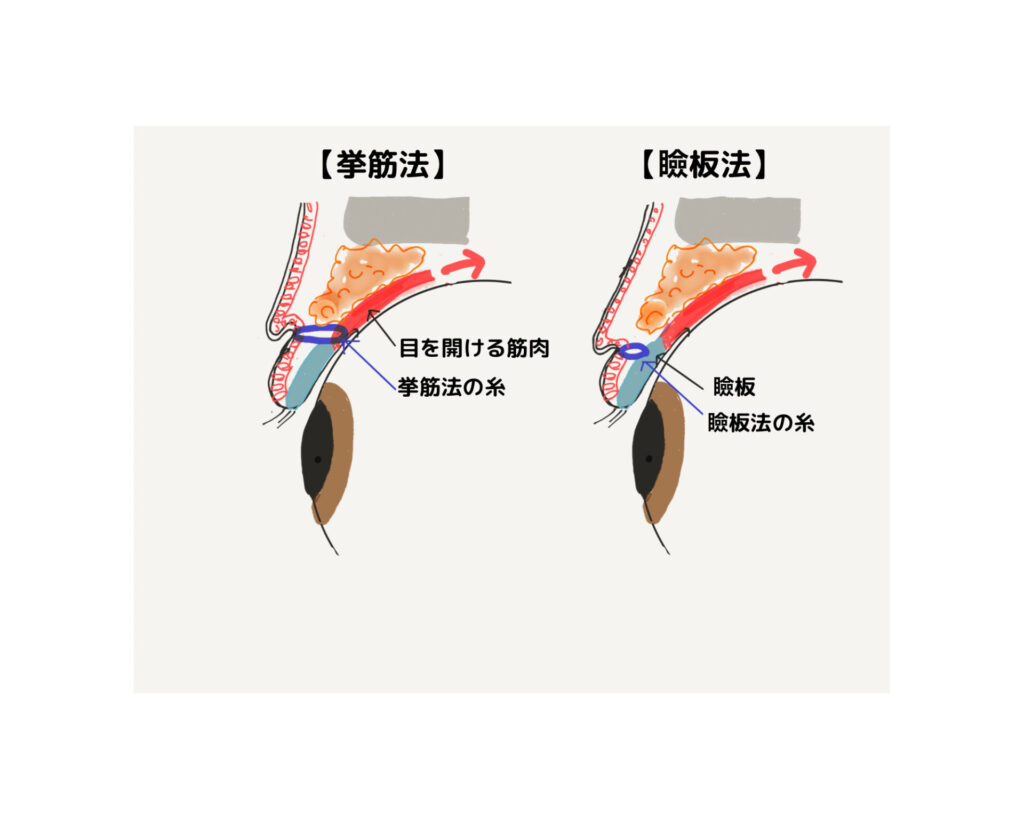
The implantation technique was a surgery that used threads to transmit the movement of the tissue that is pulled back into the eye when opening the eye to the skin of the double line, right?
The "eyelid-plate technique" transmits muscle movement indirectly to the skin of the bifocal line via the eyelid plate.
In the "elevator muscle method," muscle movement is directly transmitted to the bifurcation line.
So far, this is a review of the previous contents.
Let us explain the characteristics of each method as we compare them.
Features of Blepharoplasty and Elevator Technique
First of all, I would like to say that the ease of eyelid swelling and the difficulty of removal of the implantation technique are largely influenced by the thickness of the eyelid and the desired width of the bifocal fold. The difference between the eyelid plate method and the raising muscle method is small compared to these factors, but please consider this as the difference between the right eye and the left eye when surgery is performed using each method.
Downtime
In general, the elevator technique has less postoperative swelling than the blepharoplasty. In the elevator technique, the buried threads are tied loosely with some play to transmit the muscle movement to the skin. The eyelid-plate technique, on the other hand, ties the implant a little tighter than the elevator technique and transfers the movement of the eyelid plate to the skin. With less tension on the threads, the swelling seems to subside more quickly with the elevator technique.
However, there are cases in which the elevator myotomy also causes severe swelling. In the elevator technique, the thread passes through the muscle called Müller's muscle. There are large blood vessels in front of the Müller muscle, so if the needle tip is unlucky enough to hit a blood vessel, there may be more swelling than with the blepharoplasty. The blepharoplasty is less likely to cause severe bleeding because there are no large blood vessels in the eyelid plate that can cause significant bleeding except near the lash line.
Difficulty of removal
In the Takatorimusikata technique, a loosely tied thread transmits the movement of the muscles to the skin each time the eye is opened, pulling it in deeper. When the eyes are closed, the penetration is not noticeable, and when the eyes are open, the double fold is dynamic, just like a natural double fold.
In the eyelid-plate technique, the skin and the eyelid plate are fixed somewhat firmly, and muscle movement is transmitted indirectly to the skin via the eyelid plate.
Imagine pulling a string with a muscle and not pulling it with a muscle. Which would be easier to loosen? In general, the eyelid-plate method is more difficult to remove than the raising muscle method, when created with the same double-layer line. Incidentally, there are very few cases where the implantation threads break. Cases of implantation coming loose are caused when the threads become detached from the tissue.
Double width suitable for
For a general double fold width, either method is acceptable. However, if a narrower double fold is desired, such as a deep double fold, the raising muscle method may result in a wider finish in some cases, so the eyelid plate method is easier to create. On the other hand, if a much wider double fold is desired, the elevator technique is more suitable. It is difficult to create a double fold that is wider than the eyelid plate with the eyelid plate technique. The vertical width of the eyelid plate is said to be 8 to 12 millimeters for Japanese people, and there are cases where the eyelid plate is too small or the desired double width is too wide for the eyelid plate technique.
Risks of Blepharoplasty and Elevator Technique
Now, here is an explanation of the risks of the "eyelid plate method" and the "raising muscle method".
I will not discuss the well-known risks such as loosening of the implantation, not achieving the planned double width, and left-right difference. I will talk about the more in-depth risks for those who are taking the trouble to read the small and difficult print.
Risks of Blepharoplasty #1: Deformation of the Eyelid Plate
When tying the threads in the eyelid-plate technique, tightening the threads too tightly can deform the eyelid plate. Because the size and thickness of the eyelid plate varies from person to person, the surgeon must tie the threads with a strength that will not loosen and deform the eyelid plate for each patient. Usually, this is not a problem because the eyelid plate deformity is taken into consideration, but if the thread is too tight or the eyelid plate is too weak, the eyelid plate will deform.
What is the problem with a deformed eyelid plate? The eyelid plate is shaped to fit the roundness of the eyeball and moves smoothly up and down along the eyeball with each opening and closing of the eyelid. If the eyelid plate becomes distorted, the eye and the eyelid plate will not adhere closely together, which may cause discomfort or damage to the eyeball.
Risk #2: Corneal Damage
Compared to the eyelid plate method when it was first developed, the current method is less likely to expose the threads on the conjunctival side. If the procedure is performed correctly, the chance of thread exposure on the conjunctival side is not high. If the threads are exposed on the conjunctival side, they will rub against the eyeball every time the eyelid is opened and closed, which may damage the cornea. Even a speck of dust in the eye can cause discomfort, so if the thread is exposed, there may be some subjective symptoms. If discomfort persists after eyelid-plate surgery, it is necessary to have it checked by the clinic where the surgery was performed or by an ophthalmologist.
Risks of the Raising Eyelid Method #1: Eyelid Drooping
In the elevator technique, the threads may interfere with the movement of the muscles that open the eyes. If you experience difficulty in opening your eyes after undergoing an elevator technique, it may be due to the effect of the implantation technique. In addition to cases due to the effect of the implantation threads, there are also cases where the eye opening is temporarily compromised due to the local anesthesia or postoperative swelling. If the swelling has gone down well but the eyes remain poorly open, the possibility of a droopy eyelid due to the implantation method should be suspected.
If drooping of the eyelid occurs as a result of the implantation technique, it is likely to return to normal if the threads are removed at an early stage. Occasionally, even if several years have passed since the implantation, removal of the implantation threads during an incisional double fold can improve the eye opening. However, it should be noted that if the effects of the threads are left untreated for a long period of time, the eye opening may not return even after the removal of the implantation threads.
Risk of Eyelid Cramping
Remember in my first column on the levator anisotropic technique, I mentioned a bit of detailed anatomy? The elevator cuff threads pass precisely through the levator tendon membrane and Müller's muscle. The Müller muscle is a tricky one. Surgical manipulation of the Müller muscle can cause a condition called eyelid spasm. When you hear the word "eyelid spasm," you may think of eyelid twitching, but there are other symptoms as well. Other symptoms may occur that are difficult to recognize as eyelid spasms, such as a feeling of difficulty opening the eyes, straining between the eyebrows, blinking more frequently, or feeling dazzled by light. In some cases, not only the patient, but even the surgeon may not be aware that the symptoms are eyelid spasm.
The trouble with eyelid spasms is that in many cases they do not heal even after the threads are removed, and the number of medical facilities that can treat eyelid spasms is quite limited.
Eyelid spasm is not a complication that can be avoided if the surgery is performed with care, so it is always a risk, although the probability is low when using the raising muscle technique.
summary
This was a long and difficult column.
Probably many clinics do not explain risks, etc., in such detail in the limited time available for counseling. I myself find it difficult to explain in as much detail as I have explained in this column when discussing double width and downtime.
Reading such a column may make some people feel that "the implantation method is scary.
Resurfacing is the most commonly performed surgical procedure and has a long history since it was developed. It is important to know the risks, but there is no need to fear them more than necessary. It remains a safe and relatively easy surgical procedure.
Now, the topic of implantation continues.
See you in my next column.
Thank you for reading to the end.
Assistant Director Daiki Kuroda
# Dr. K's In-Depth Commentary Series
Supervisor of this article
vice president (of a hospital, clinic, etc.)
Daiki Kuroda
OHKI KURODA
Share Article