 Doctor's Column
 Staff Blog
 campaign
 News
News





2023.08.25
double-entry burial
To properly understand the implantation process

Dr Kuroda
My name is Kuroda, Deputy Director.
In this issue, we will discuss the most popular cosmetic surgery procedure, implantation.
The implantation method employed by each clinic varies and has many different names.
Many people's first cosmetic surgery is implantation.
The information out there is so jumbled up that it is difficult to know what to believe.
Therefore, we will provide an in-depth explanation of the implantation double surgery.
Knowledge of the anatomy of the eye area is necessary to properly understand the implantation technique.
Some of the content is a bit difficult, but do your best to read it.
CONTENTS
What is double?
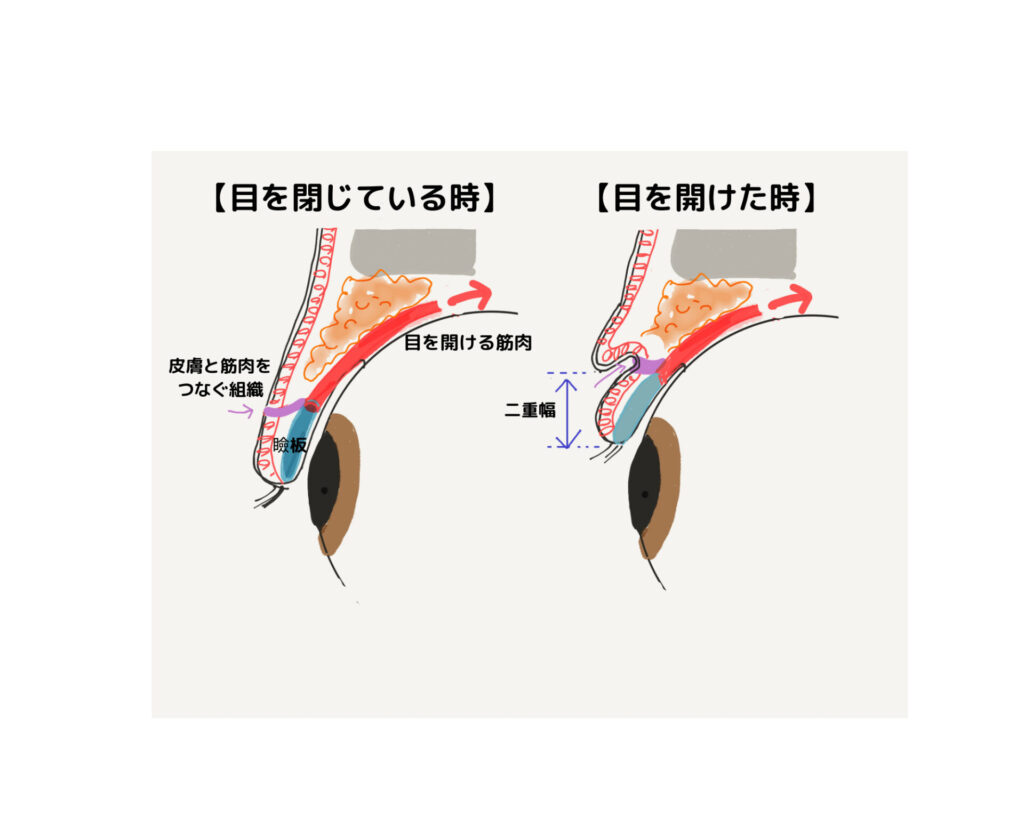
Illustration of a cross-sectional view of the vertical axis of the eye.
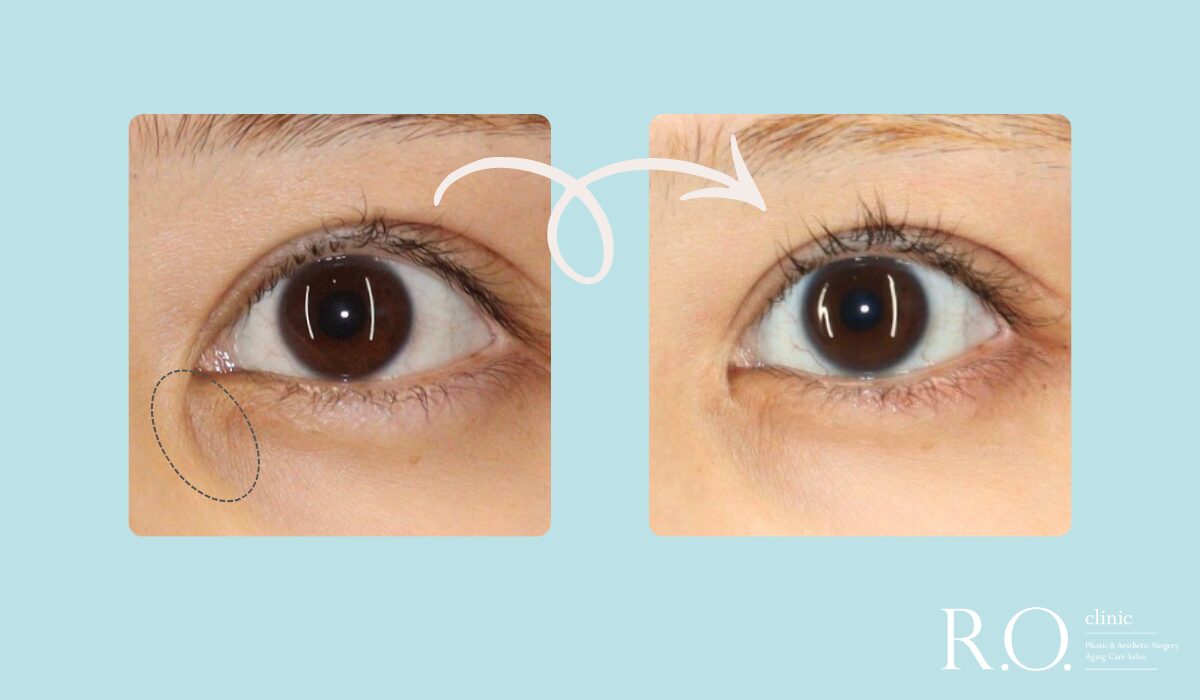
As the skin of the bifurcation line is drawn in diagonally back along the eyeball, the skin on the brow side is folded in two and covered. The visible area between the eyelash line and the covered skin is the so-called double width.
Although people with a natural double fold have fibrous tissue between the skin of the double fold line and the muscles that open the eyes,
People with a single or double fold have no or weak fibrous tissue.
The implantation procedure is to have the threads do the work that that fibrous tissue does instead.
Types of implantation methods
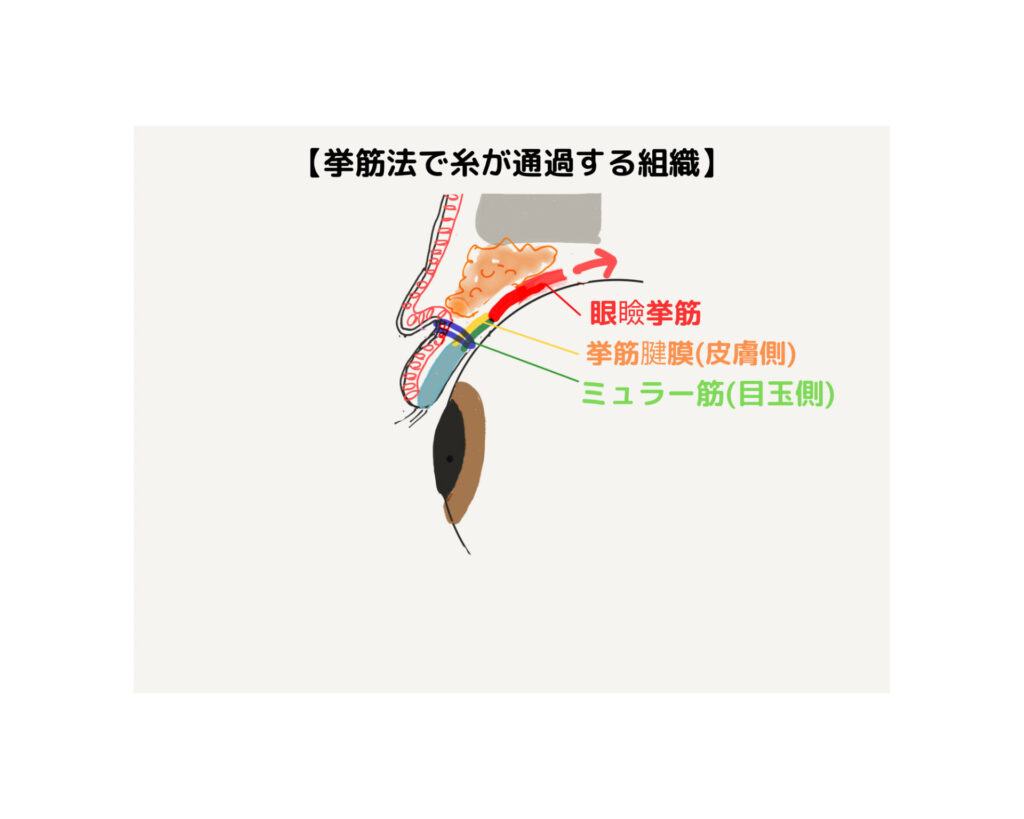
At the tip of the eyelid is a collagen plate called the eyelid plate. The muscles that open the eyelids are connected to the eyelid plate, and when the eye is opened, the eyelid plate is pulled up by the muscles so that it glides along the eyeball.
The "Eyelidoplasty" creates a threaded connection between the eyelid plate and the skin, while the "Elevator Technique" creates a threaded connection between the eye-opening muscles and the skin.
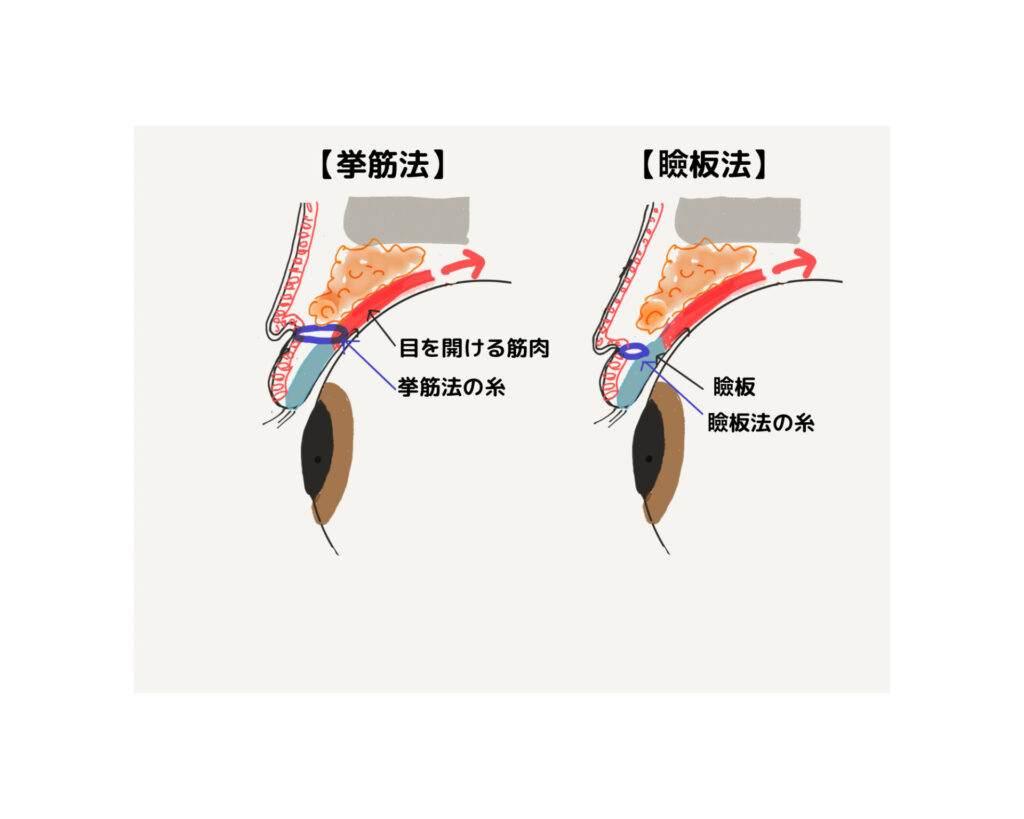
This is a bit more technical.
If you feel your mind is jumbled after the explanations up to this point, you can skip to the next illustration without any difficulty.
The muscle that opens the eye is the eyelid elevator muscle.
The levator muscle is divided into the levator tendinis superficialis and Müller's muscle on the side of the eyeball on its way from the back to the front of the eyeball, each of which raises the eyelid plate.
In the elevator technique, the thread passes through the levator tendon membrane and Müller's muscle.
The reason why I am going into such detail is that an understanding of the Müller muscle is necessary when I explain the risks of the raising muscle technique later on.
The way the threads that pull the skin in can also be used to classify them.
Fixation at a single linear point to the skin is "point fixation," fixation at a plane with a looped thread to the skin is "loop fixation," and a more complex combination of loops is "complex loop fixation.
The thread must be tied so that it does not unravel, so the knot becomes a ball of thread.
The "front clasp" has the ball of thread on the skin side, while the "back clasp" has the ball of thread on the eyeball side.
Related to yarn balls, incidentally, there is also a way to create multiple knots in a single piece of yarn.
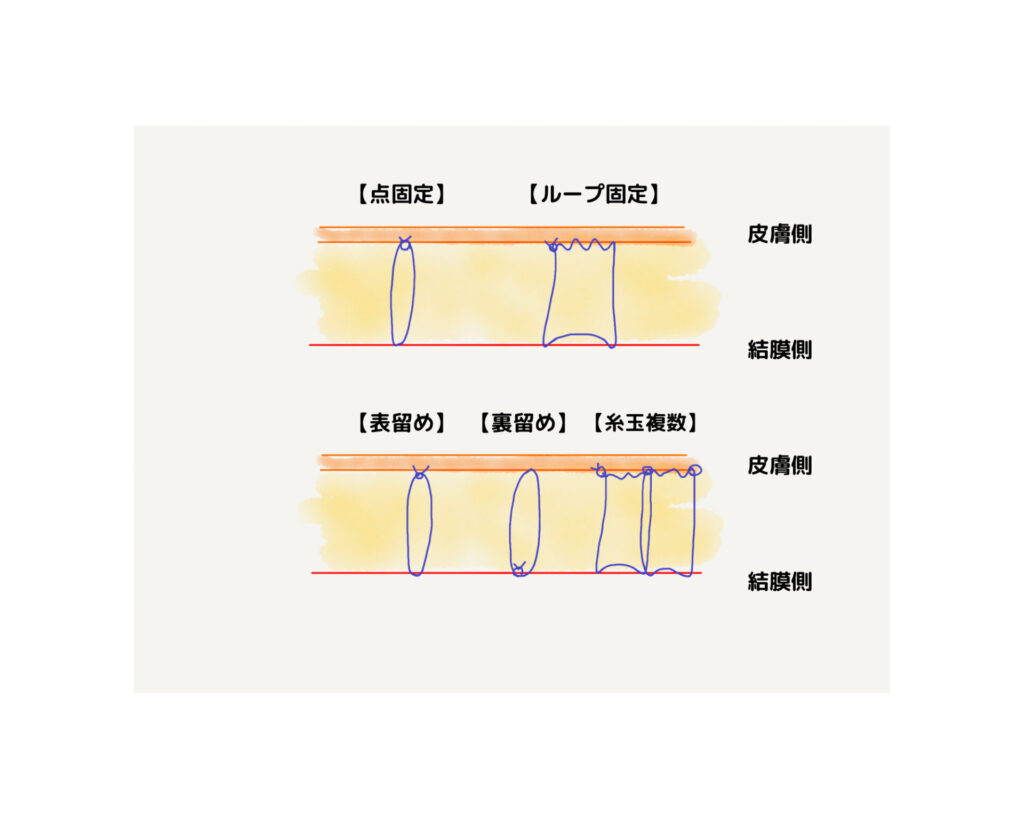
There are many different methods of implantation in the world, but basically it is a combination of these methods.
Even if I were to offer an implantation method that I named the "Dr. K Original Special Hybrid Method," it would ultimately be nothing more than a combination of these methods.
summary
Now, if you can understand this much,
Which is better, the blepharoplasty or the elevator technique?
What are the risks of implantation?
Who is suitable and unsuitable for the implantation method?
How many times can I have a bunion?
How long does the implantation method last?
This is a good basic knowledge to understand the explanations for the questions we often receive from patients, such as
In the next article, we will discuss in depth the difference between the eyelid plate technique and the raising of the eyelids technique.
Assistant Director Daiki Kuroda
# Dr. K's In-Depth Commentary Series
Supervisor of this article
vice president (of a hospital, clinic, etc.)
Daiki Kuroda
OHKI KURODA
Share Article