 Doctor's Column
 Staff Blog
 campaign
 News
News





2023.10.27
hump osteotomy
About the Roman nose

Dr Kuroda
The theme of this issue is the "eagle nose.
CONTENTS
What is an eagle nose?
The term "eagle nose" refers to the convex shape of the middle of the nasal tip when viewed from the side.
Medics call it hump.
The convex part of the nose is composed of bone and cartilage: the upper part of the convexity is the nasal bone, and the lower part is the nasal septum cartilage and lateral nasal cartilage.
Touch the bridge of your nose from above as if you were holding it between your thumb and forefinger. You will feel hard bone in the upper 1/3 of the area, but from the middle of the area, you will feel thin and movable cartilage, right? If the joint between the bone and cartilage is raised, you have an eagle nose.
People with a prominent nose often have an overall appearance of a large nose with a drooping nasal tip.
The more drooping form of the nose tip is sometimes called a hooked or witch nose.
A prominent nose looks masculine.

The tip of the nose is the main part of the nose
Now, what do you think is the most important part of the nose?
I consider it "right under my nose".
Of course, the nasal stripe and the nose are important, but the tip of the nose is the star of the show.
The biggest problem with a crooked nose is that the nose tip, which plays a supporting role, is so assertive that it eats away at the presence of the main actor, the nose tip.
In order for the tip of the nose to stand out beautifully, the supporting nasal stripe needs to take a step back. The nasal bridge should be flat or slightly warped toward the tip of the nose to accentuate the tip of the nose.
Hump osteotomy (eagle nose correction) is necessary for people with an eagle nose to achieve such a nasal stripe.
The nasal bones are shaved and cartilage is removed to morph the nose so that a beautiful nasal stripe is achieved.
Case Studies
Let's look at an actual case.
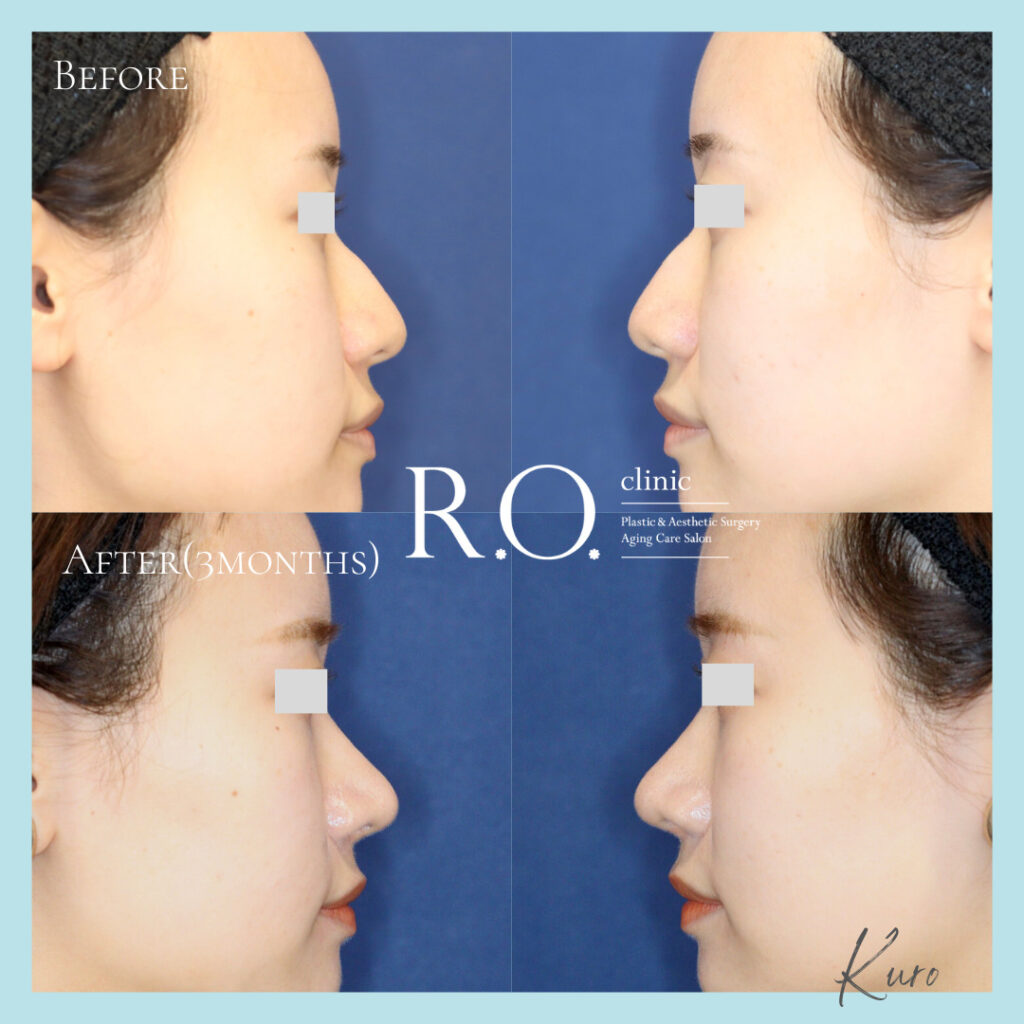
Nasal tip height and slenderness are created by a nose tip augmentation + auricular cartilage grafting, while the eagle nose is corrected by hump osteotomy. By adding the nasal tip and subtracting the nasal stripe, we have achieved a balance where the nasal tip plays the leading role and the nasal stripe plays a minor role.
Nose is all about balance.
Since the nose is a masculine looking eagle nose, it tends not to be preferred by women.
Some women, however, have attractive facial features despite their eagle noses.
Yasuko Matsuyuki, Yuki Amami, Keiko Kitagawa, and others have attractive faces despite their eagle noses.
By far, the most common characteristic of people with attractive noses, even with a prominent nose, is a beautiful nose tip.
Specifically, there is sufficient height at the nasal tip, slenderness at the nasal tip, and a good balance between the nasal tip and nasal wings. With those conditions in place, even an eagle nose can look attractive.
To illustrate the previous analogy, even if the nose tip of the supporting actor is protruding, the tip of the leading actor shines brighter than the supporting actor, so that the eagle nose does not look bad.
On the other hand, those with nasal problems often have insufficient height at the nose tip, a rounded nose tip, or an imbalance between the nose tip and the nasal wings. For such people, trying to create a nose tip that is competitive with the eagle nose can be overwhelming in many ways, so having the nasal stripe take a step back and the nose tip take a step forward will help balance the two.
In some cases, patients may judge themselves to have an eagle nose, but in reality, the nose tip is drooping, giving the appearance of an eagle nose.
In the case of a mild eagle nose, the height of the nasal tip can be increased without removing bone or cartilage, and the concavity of the upper and lower parts of the nose can be camouflaged by grafting auricular cartilage or other grafts.
During the consultation, a 3D image simulator can be used to confirm how the impression of the nose will change if the eagle nose is improved. Please feel free to consult with us as we will propose a treatment method according to the degree of your nose.
Assistant Director Daiki Kuroda
#Dr. K's In-Depth Commentary Series
Supervisor of this article
vice president (of a hospital, clinic, etc.)
Daiki Kuroda
OHKI KURODA
Share Article