 Doctor's Column
 Staff Blog
 campaign
 News
News





2023.10.20
auricular cartilage graft
About Auricular Cartilage Grafts

Dr Kuroda
In this article, I will explain my practice of auricular cartilage grafting.
CONTENTS
What is an auricular cartilage graft?
Auricular cartilage transplantation is a procedure in which an incision is made behind the ear and ear cartilage is harvested and transplanted into the tip of the nose.
Since downtime is short and complications are few, this is a popular procedure for those who do not want to undergo a very major surgery or who do not want to take as many risks as possible.
Surgery is often performed under local anesthesia, but can also be performed under intravenous anesthesia for those who are more anxious.
Basically, it is done in a closed method, so there will be no scar on the exposed area of the nose. A cast is not required and stitches are removed from the ear and nasal cavity after one week.
After the stitches are removed, the skin of the nose will be slightly edematous, but not so much that it must be covered by a mask. On average, a change of 2 to 3 mm can be expected.
People who are prone to change
Some people are more prone to change than others with auricular cartilage grafts.
In order to make sure that the auricular cartilage grafts make a good change.
Nose skin softness
Strength of nasal wing cartilage
The two most important are
Nose skin softness
Good skin extensibility at the tip of the nose facilitates the changes caused by the grafted cartilage.
For those who have a history of nasal tip surgery or other skin hardness that makes it difficult to stretch, a nasal septal extension rather than an auricular cartilage graft should be used to create a foundation that will not be compromised by skin hardness. That said, unless the skin at the tip of the nose is very hard, it is possible to make changes with auricular cartilage.
Strength of nasal wing cartilage
The cartilage to be transplanted is placed on top of the nasal wing cartilage, which is the cartilage at the tip of the nose. If the cartilage of the foundation, so to speak, the foundation of the building, is strong, it is easier to change and less likely to revert. If an auricular cartilage graft is performed on a nose that easily collapses when the tip of the nose is pressed with the finger, the graft will not be able to support the weight of the skin and grafted cartilage and will collapse, leaving unsatisfactory results.
Auricular cartilage grafting is a simple procedure, but we have devised ways to achieve consistent results. Here are some of our innovations.
(Ingenuity 1) Guiding the transplanted cartilage with thread
In the auricular cartilage graft close procedure, processed auricular cartilage is inserted into the nasal tip through an incision in the nasal cavity. The location of the grafted cartilage determines which part of the nasal tip is extended.
The common method is a blind operation, in which cartilage is inserted at approximately this location and that is the end of it. However, this method has the risk that the transplanted cartilage may be slightly shifted up, down, left, or right.
In my surgery, to precisely lengthen the nasal tip, I guide the grafted cartilage to the targeted position by threading it through the nasal cavity to the tip of the nose.
(Ingenuity 2) Reinforcement of nasal wing cartilage as a foundation
As mentioned above, the stronger the underlying nasal wing cartilage, the easier it is to make changes. I have made some modifications to make it possible for people with weak nasal wing cartilage strength to achieve changes. I reinforce the nasal wing cartilage by suturing the areas where the cartilage tends to sink, or by grafting cartilage that will serve as a support. It is difficult to thread the narrow surgical field of the closed technique, and depending on the threaded area, the nose may be up-nosed, so it is necessary to determine where the nasal wing cartilage should be reinforced.
This is the method that many doctors use when performing nasal apex formation using the open method, but I believe that only a minority of doctors go to this much trouble for a closed method auricular ointment grafting only.
Other factors such as the size and processing of the auricular cartilage to be transplanted and the depth to which the skin of the nasal apex is peeled off are also changed depending on the patient's nasal condition.
Case Studies
Finally, here are some actual cases.
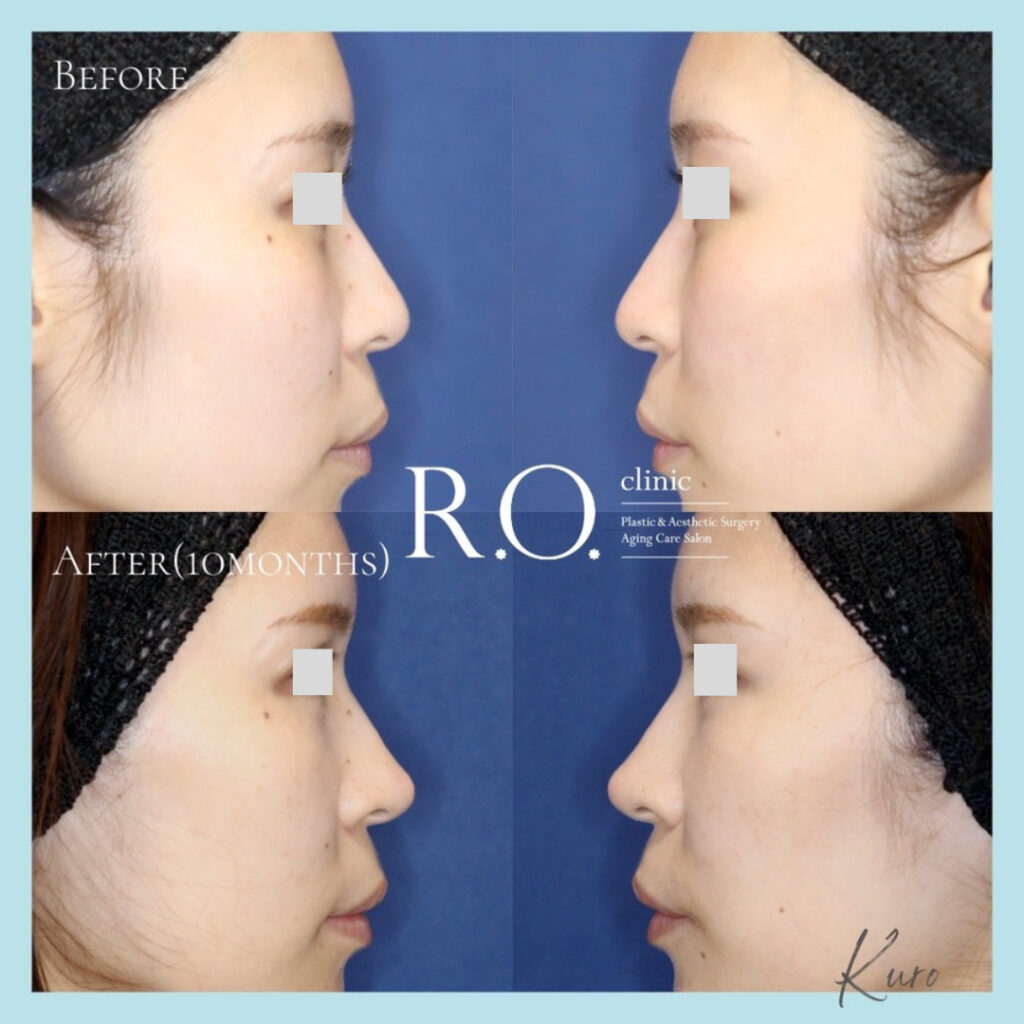
This is a case of auricular cartilage graft to increase the height of the tip of the nose. This level of change can be expected in a person with soft skin.
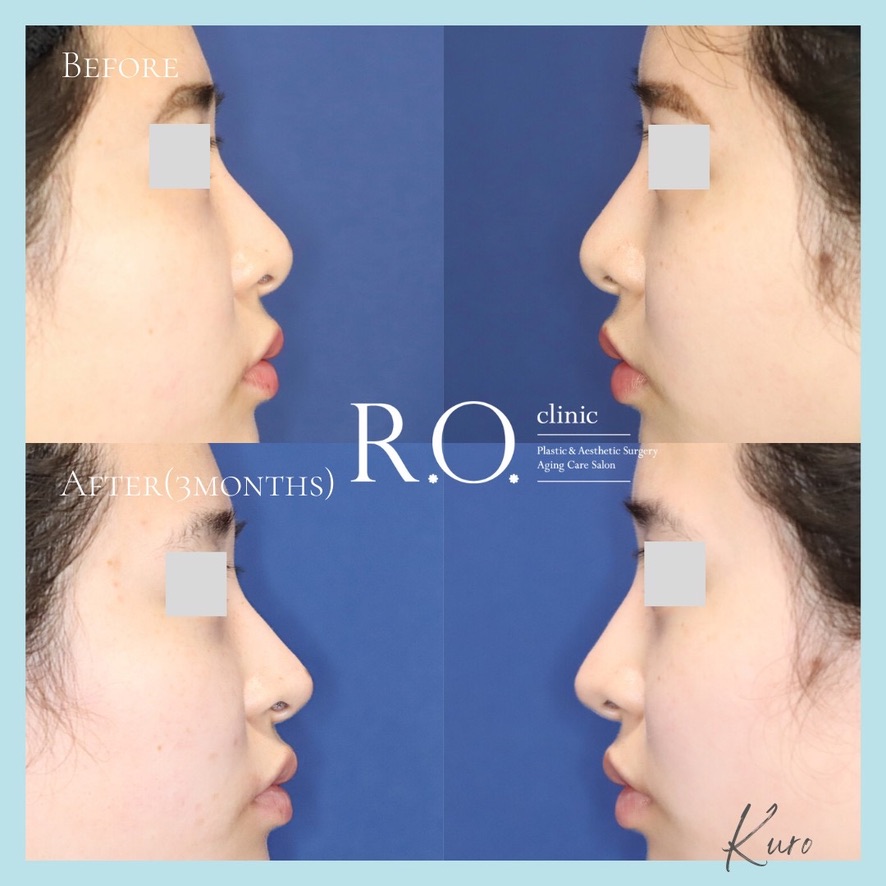
This is another case of nasal tip height. By reinforcing the underlying nasal wing cartilage, a firm change can be achieved compared to a simple auricular cartilage graft.
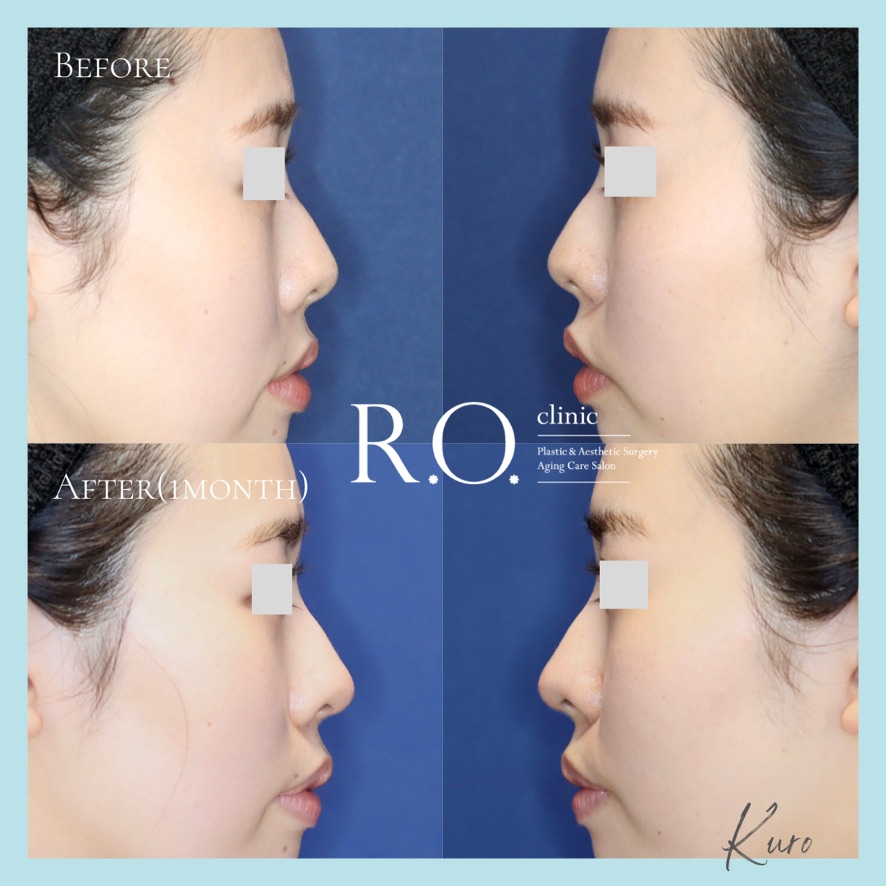
The patient tends to have a short nose, and an auricular cartilage graft was performed to increase the length of the nasal apex. Auricular cartilage grafting is more difficult to lengthen than to heighten. A good deal of ingenuity is required to reduce the nasal apex to this level using only the auricular cartilage graft close method alone. If you wish to make further changes, nasal septum extension is indicated.
The auricular cartilage grafting close procedure is a simple yet profound surgery, and a hidden effort by the surgeon can make a difference in the results. Although I also perform full nasal augmentation such as nasal septum extension and osteotomies, I am exceptionally particular about the auricular cartilage grafting close procedure as a less burdensome method for my patients.
Assistant Director Daiki Kuroda
# Dr. K's In-Depth Commentary Series
See details of the treatment related to ▼ column here.
Supervisor of this article
vice president (of a hospital, clinic, etc.)
Daiki Kuroda
OHKI KURODA
Share Article