 Doctor's Column
 Staff Blog
 campaign
 News
News





2024.04.12
auricular cartilage graft
nasal septum extension
What does rhinoplasty do?

Dr Kuroda
CONTENTS
What is rhinoplasty?
I think it is difficult to imagine what exactly a rhinoplasty is.
It may say "nasal tip reduction" so
Surgery to thin the tip of the nose
Surgery to improve the appearance of a bulbous nose
Is this the image you have in mind?
Rhinoplasty is a "nose tip shaping" procedure.
Although it is often used to thin or raise the tip of the nose, rhinoplasty is also used to turn the tip of the nose up-nosed or lengthen it.
Technically.
Changes to the nasal wing cartilage to frame
Adjust the thickness of the skin at the tip of the nose.
is what is done in rhinoplasty.
Combined treatment with rhinoplasty
So, is it possible to achieve the desired change with rhinoplasty alone?
In cases where the skin is thin and the nasal wing cartilage is large, rhinoplasty alone can produce changes.
However, in many cases, Asians have thicker skin and smaller nasal wing cartilage, so it is common to transplant cartilage from other areas to strengthen the frame while reducing the thickness of the skin.
Strengthening the frame is effective in preventing mid- to long-term retroversion, and "struts" and "nasal septum extension" are commonly used to reinforce the frame.
Struts are implanted between the left and right nasal wing cartilages to provide a supporting cartilage to counter the forces that cause the nasal apex to lower.
Nasal septum lengthening also uses grafted cartilage to lengthen the nasal septum, creating a firm foundation while sacrificing some movement of the nasal apex.
In many cases, struts can be used for the purpose of raising or thinning the tip of the nose, while nasal septal extension is often used to lengthen the tip of the nose. However, if the conditions of the nasal wing cartilage and nasal septum cartilage are good, it is possible to lengthen the tip of the nose without septal extension.
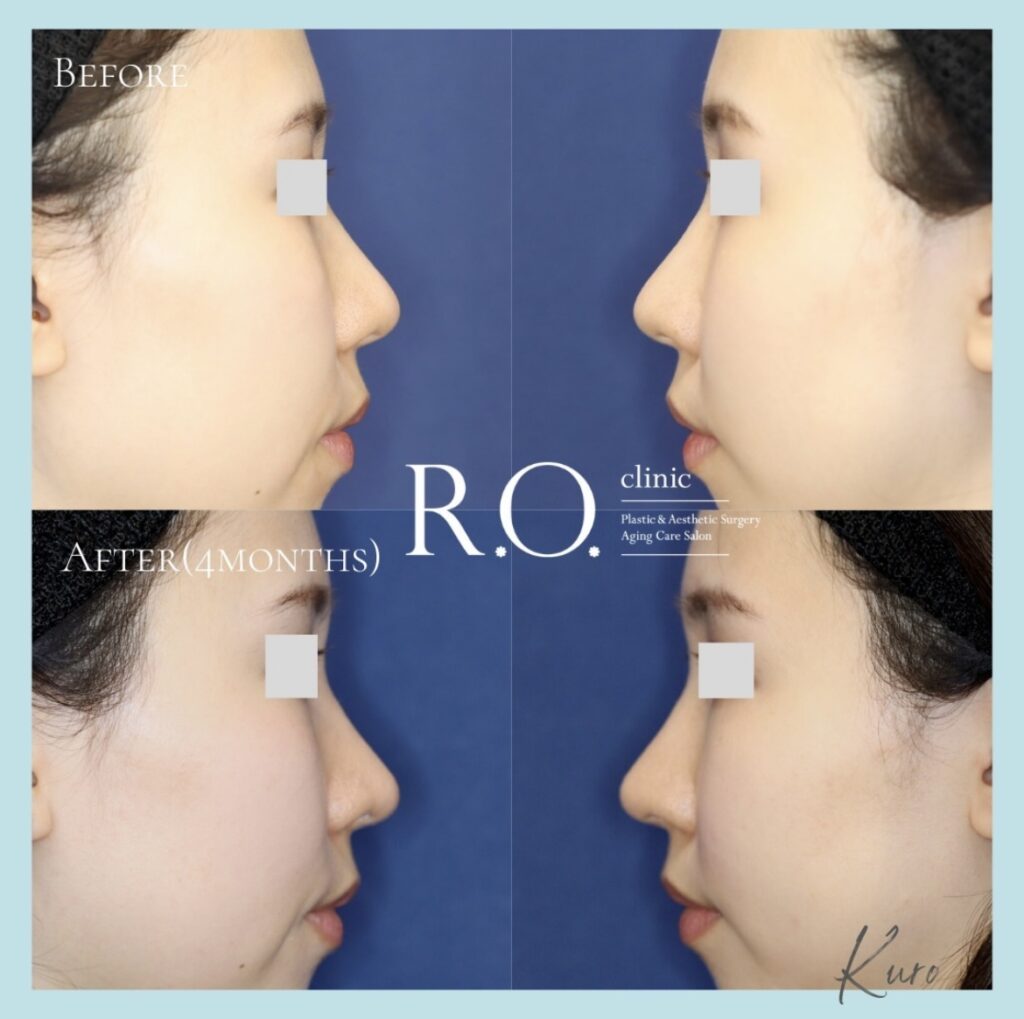
In this case, nasal septum extension was not performed, but nasal tip lengthening and up-nose feeling was improved only by nasal tip augmentation and auricular cartilage grafting.
Rhinoplasty is a surgery that uses a variety of techniques depending on the case. I am often asked the question, "What method do you use for rhinoplasty?" It is difficult to say in a few words, "My rhinoplasty is the ⚪︎⚪︎ method.
As an example, the following is a description of a case in which rhinoplasty and auricular cartilage grafting were performed.
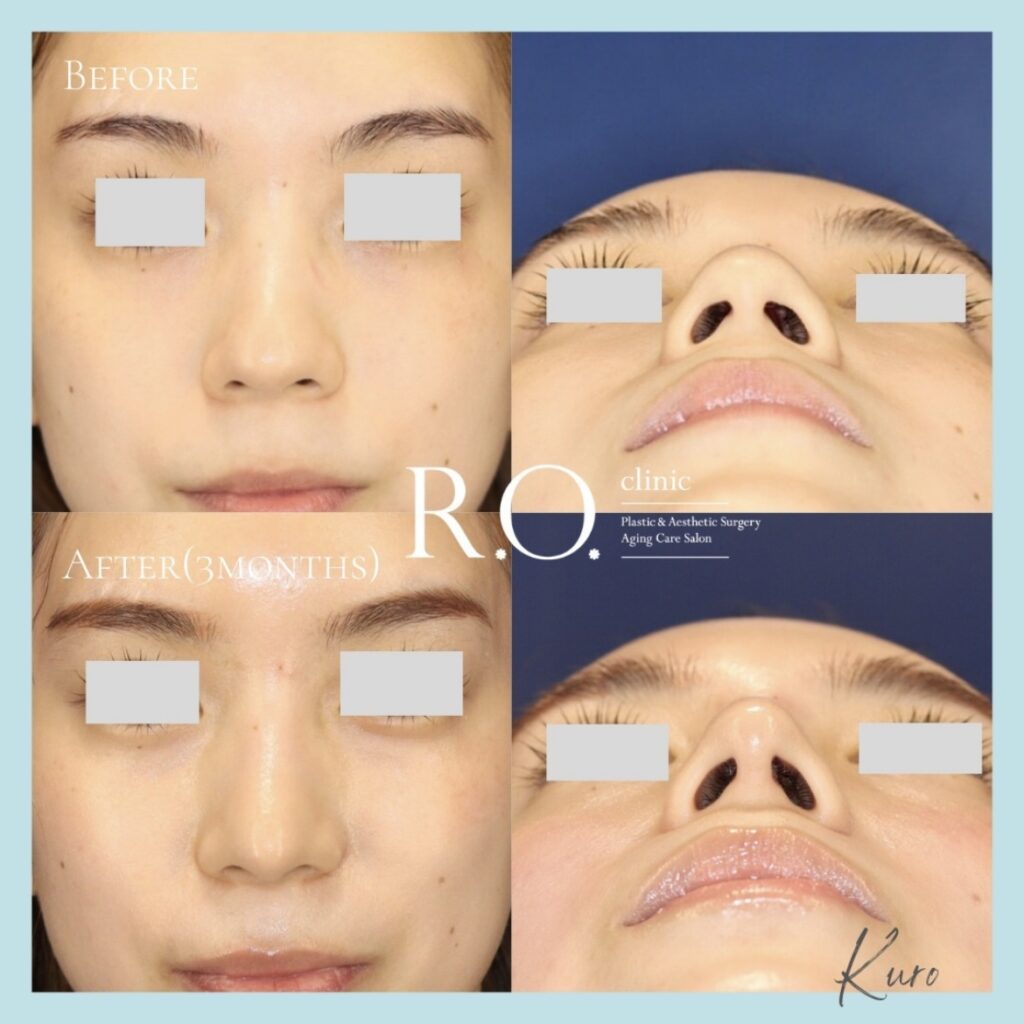
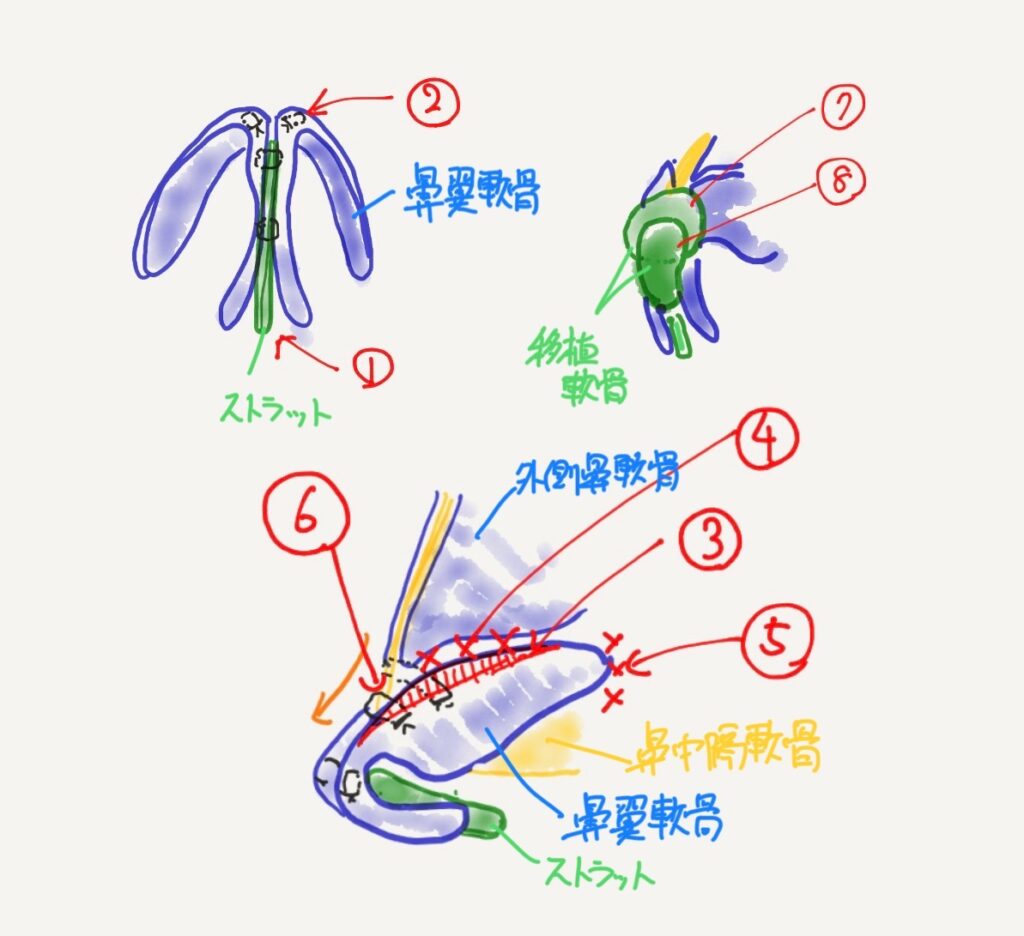
Frame Reinforcement
1) Reinforcement of the medial leg of the nasal wing cartilage with struts
Nose tip: Serves as a foundation to prevent the tip of the nose from collapsing
Manipulation of nasal wing cartilage.
(2) Nasal wing cartilage dome suture
Reduce the roundness of the nose tip and make it thinner.
(iii) Resection of lateral leg cephalic side of nasal wing cartilage
: Reduce the size of the cartilage at the tip of the nose by excising excess cartilage
(4) Ligamentous ligament transection between the nasal wing cartilage and lateral nasal cartilage
: Facilitates movement of the cartilage at the tip of the nose into the proper position.
(5) Incision between the nasal wing cartilage and the foramen pellucidum
: Facilitates movement of the cartilage at the tip of the nose into the proper position.
(6) Nasal tip extension suture
Nasal wing cartilage is anchored to the nasal septum cartilage in a position that lengthens the tip of the nose.
Manipulation with Allograft Cartilage"
(7) Onlay grafts
Nose tip height is fine-tuned with cartilage grafts.
(viii) Shield graft
Fine-tune the length of the nasal tip with grafted cartilage.
Manipulation of skin
(9) Partial excision of deep fat layer and fibromuscular layer
Adjust the thickness of the skin so that it reflects the shape of the prepared frame.
This is all the techniques involved in the surgery called rhinoplasty. This is just an example, and other methods may be used in some cases.
summary
The reason why it is difficult to understand what rhinoplasty involves is that there are many techniques included in the single category of rhinoplasty, and what is done depends on the case. Although the techniques required differ from case to case, we are always striving to improve our skills to provide the best rhinoplasty to meet the patient's needs.
Assistant Director Daiki Kuroda
#Dr. K's In-Depth Commentary Series
See details of the treatment related to ▼ column here.

Supervisor of this article
vice president (of a hospital, clinic, etc.)
Daiki Kuroda
OHKI KURODA
Share Article