 Doctor's Column
 Staff Blog
 campaign
 News
News





2024.01.19
Other
Pain from local anesthesia

Dr Kuroda
Surgery and local anesthesia are inseparable.
Many people are afraid of surgery but are worried about the pain of local anesthesia.
On the other hand, patients who have undergone surgery at our hospital have told us
The anesthesia was painless."
'The anesthesia was painful at other clinics, but at RO it was fine.'
We are often asked to say.
In this issue, we will explain our clinic's efforts to reduce the pain of local anesthesia.
CONTENTS
Ingenuity 1: Thinness of the injection needle
Our clinic uses an ultrafine needle for injections of local anesthesia. Let's compare the 33G (gauge) needle used at our clinic with the 27G and 25G needles that are generally distributed as thin needles. Incidentally, the larger the gauge number, the thinner the needle.

Compared to the 23G used for blood sampling in health checkups, etc., can you feel the fineness of the 33G?
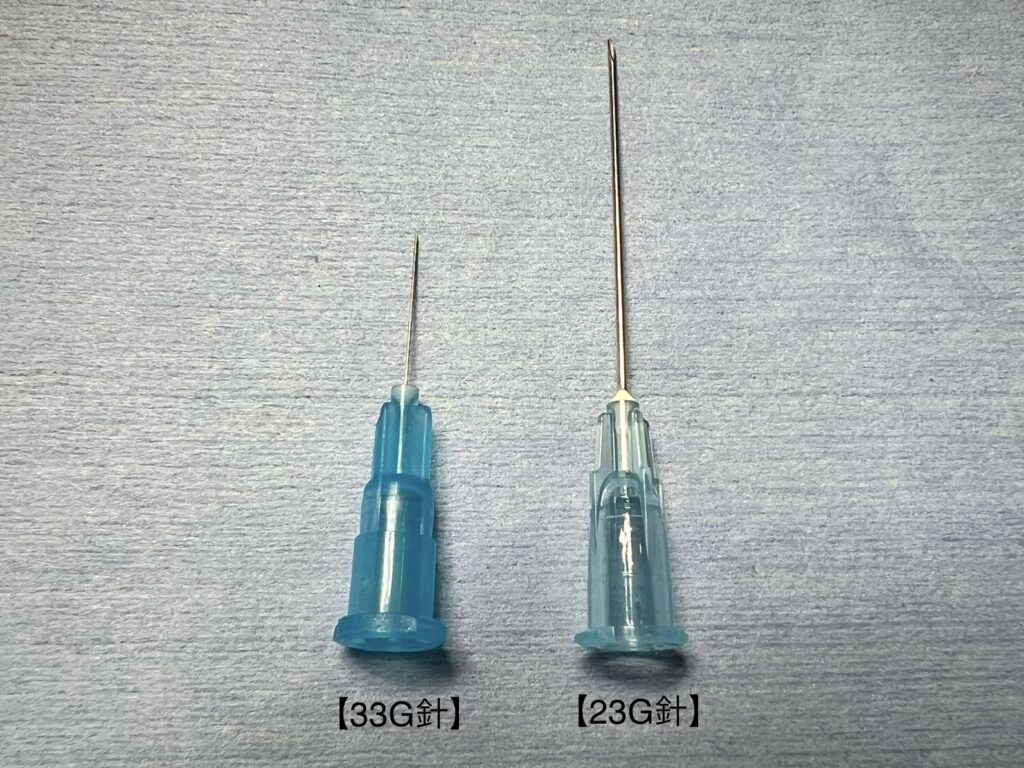
By comparison, you can see how thin the 33G needle is. Naturally, the thinner needle causes less pain.
Device 2: pH of anesthetic solution
Agents used for local anesthesia are acidic in pH. When used as a local anesthetic, a small amount of sodium bicarbonate is mixed in to bring the pH closer to neutral. By keeping the pH level close to neutral, we can reduce the pain that is felt when the drug enters the tissues.
Device 3: Surface anesthesia
Anesthetic cream is applied in advance to the area where the needle is to be inserted. The anesthetic cream dulls the sensation of the skin, which reduces the pain when the needle is inserted.
Device 4: Temperature of anesthetic solution
The local anesthetic solution is stored in a refrigerator, so it is very cold immediately after it is taken out of the refrigerator. Cold anesthetic solution is very painful when injected, so we wait until the anesthetic solution reaches room temperature before injecting it.
Ingenuity 5: Needle site
Skin perception is not the same everywhere. Some areas are more sensitive to pain than others, while others are relatively less painful. In the case of the eyelid, the area from the outer corner of the eye is less painful than the area from the inner corner of the eye, so we always inject from the outer corner of the eye. Once local anesthesia is given to one area, the second and subsequent needles can be injected from the area where the local anesthesia is in effect, so the pain of the needle prick is hardly felt.
Ingenuity 6: Stretching the skin
The most painful part of an injection is the moment when the needle pierces the skin. By stretching the skin where the needle is inserted with your finger, you can reduce the chance of the needle hitting the painful point on the skin. The sensation of the skin being stretched also has the effect of easing the pain of the needle.
Ingenuity 7: Injection rate of anesthetic solution
Many of you may remember how painful it was to be injected with a pew in about one second, such as with a flu shot. If the drug is injected too quickly, the tissue is rapidly pushed open, resulting in strong pain. To reduce pain, it is possible to greatly reduce pain by injecting the drug as slowly as possible. I inject the flu shot myself, but I do it so slowly that I can't inject any slower, and it hurts a lot less than when I inject it in one second.
Device 8: Block anesthesia
Sensory nerves in the face exit the skin through holes in the bone. Anesthesia around the area where the nerve emerges from the bone allows anesthesia to be applied to a large area of skin using less anesthetic solution. Block anesthesia is especially useful for surgeries on the nose, mouth, forehead, and lower eyelids. The initial block anesthesia can greatly reduce the pain of subsequent local anesthesia.
Ingenuity ⑨: Calling out
Bufferin's famous catchphrase, "Half of it is made up of gentleness," is also half of what makes local anesthesia painless. If a patient is tense and stiff, both I and the nurses talk to them to relieve their tension as much as possible. I also call out to them when touching their skin or inserting needles, and take great care not to cause sudden and unintended unpleasant sensations.
I was a resident about local anesthesia.
If the local anesthesia causes pain, the patient's evaluation of the procedure will be lowered even if the subsequent surgery goes well. Everyone is a bad surgeon at first, so at least try to make them say that the anesthesia was painless."
I was taught by my supervisor to do so.
I was told this almost 20 years ago, and I still keep this lesson in mind when administering local anesthesia. Although it may be difficult to achieve zero pain, we strive to ensure that our patients feel that the local anesthesia is not as painful as they had imagined.
Assistant Director Daiki Kuroda
#Cosmetic Surgery Yoyamatogatari Series
Supervisor of this article
vice president (of a hospital, clinic, etc.)
Daiki Kuroda
OHKI KURODA
Share Article