 Doctor's Column
 Staff Blog
 campaign
 News
News





2023.12.01
double incision
Upper eyelid sagging excision
Eyelid thickness

Dr Kuroda
CONTENTS
My eyelids are thick, aren't they?"
This is a question often asked in counseling.
The thickness of the eyelid varies greatly from person to person, and while some people suffer from thicker eyelids, others suffer from thinner eyelids that give the appearance of hollow eyes.
In cosmetic surgery, thick eyelids can be a problem when creating a double fold.
A stick called a bougie is placed on the eyelid to simulate a double fold, and if the skin folds smoothly during this process, there is no problem.
If the bougie returns to a single layer as soon as it is removed, or if the bougie does not double up when applied, some countermeasure is necessary.
Tissue that can be surgically removed is in order from shallowest to deepest.
Skin
Orbicularis oculi muscle
ROOF
Orbital fat
anterior segment of the eyelid
will be.

skin
The eyelid skin is thinner near the eyelashes and thicker closer to the eyebrows. If a person with thick eyelid skin has the skin removed at the bifurcation line, the skin in the thin area will be lost, resulting in an increase in thickness.
If the skin is thick and sagging, the thicker skin can be preferentially excised through an incision under the brow for a clearer appearance. In individuals with less sagging skin and lower eyebrows, a forehead lift may be indicated.
orbicularis oculi muscle
The orbicularis oculi muscle is the muscle that closes the eyelid, and partial excision does not cause functional problems. Excision of the orbicularis oculi muscle on the lash side of the double fold line will reduce the volume above the lashes. While excision of the orbicularis oculi muscle has the advantage of creating a clear double fold that is difficult to remove, it also has the disadvantage of creating a double fold that is flatter and less mobile, or one that has a noticeable difference in thickness at the border of the double fold line when the eyelid is closed. The orbicularis oculi muscle on the brow side of the double fold line is not excised, because if it is excised, an unscheduled eyelid line will appear, resulting in a triple fold.
However, the thickness of the upper eyelid can be safely reduced by removing the orbicularis oculi muscle just below the skin to be removed during the submental incision.
ROOF
It is fibrous fatty tissue located under the orbicularis oculi muscle. It cannot be pulled out smoothly like the orbital fat described below, so it is excised as if it were scraped from the surrounding tissue. By excising it, the volume of the upper eyelid and under the eyebrows can be reduced. Although it can be removed through an incisional double incision, it is safer to remove it through an incision under the eyebrow. In addition to surgery, fat dissolving injections can also be used to reduce the volume. If too much is removed, there is a risk that the eyelid may become less firm or adhere to the orbicularis oculi muscle, resulting in an unscheduled double eyelid line, so it is not removed in patients with normal eyelid thickness.
orbital fat
This is the fat that is removed in the so-called eyelid fat removal. It is this fat that is removed through a few millimeters incision during the implantation procedure. It also serves as a lubricant for the levator muscle to glide smoothly, and if too much is removed, there is a risk of a sunken eye or an unscheduled eyelid line.
People with a lot of orbital fat often have a lot of fat hanging down to the area around the double fold line, and by excising an appropriate amount, the effect of making the double fold line on the outer corner of the eye sharper and easier to fold can be expected. Since the fat is located deep, the eyelid thickness will not be reduced as much as expected after excision.
anterior segment of the eyelid
People who are naturally ham-eye-like have a lot of tissue volume in front of the eyelid plate. Resection of this tissue can create a double fold that is difficult to remove by clearing the area above the lashes. Because the elevator tendon membrane attaches to the eyelid plate, the adhesion between the frontal tissue and the elevator tendon may loosen during excision, resulting in a droopy eyelid. If the adhesion between the levator tendon and the eyelid plate is loosened, re-fixation may be necessary.
Thick eyelids reduce the volume of these tissues, but in the majority of cases, all tissues are thicker in fullness rather than only in certain tissues.
Here is a case study of a monitor patient who had thick eyelids.
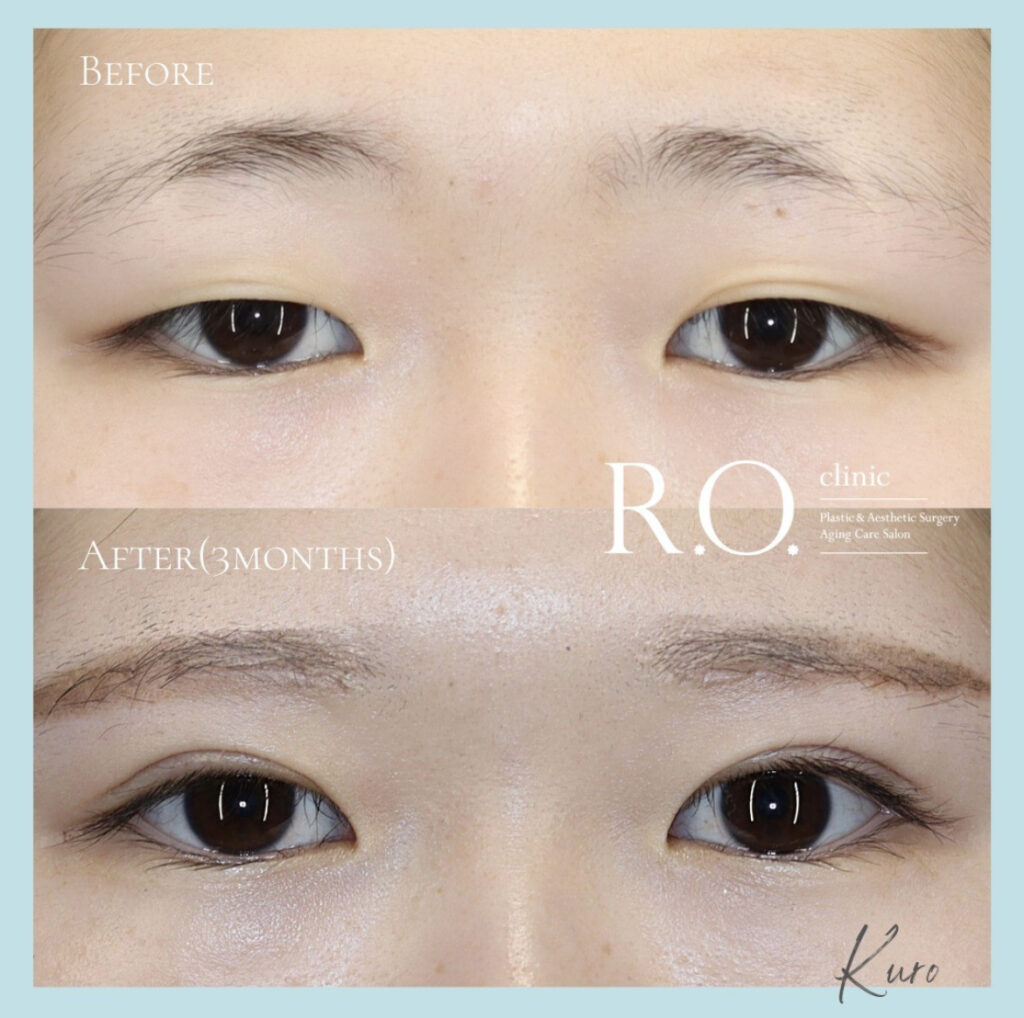
She wanted a natural double fold of the terminal type, but her eyelids were thick and the skin did not fold in the desired double fold line even when a bougie was applied. We removed the thick skin, orbicularis oculi muscle, and ROOF through an incision under the eyebrow, and performed an incisional double fold one month later. During the incisional double fold, we also reduced the orbital fat, orbicularis oculi muscle, and anterior tissues of the eyelid plate.
Thus, it is possible to create a double fold even with thick eyelids if the necessary tissue is reduced in a step-by-step fashion. However, since the skin is still thick, it is important to note that a wider double width will result in an eyelid that is noticeably thicker and more like a plastic surgery.
The order in which and how to remove the tissue causing the thickness is determined based on the desired double fold shape and the condition of the eyelid.
Assistant Director Daiki Kuroda
#Dr. K's In-Depth Commentary Series
See details of the treatment related to ▼ column here.

Supervisor of this article
vice president (of a hospital, clinic, etc.)
Daiki Kuroda
OHKI KURODA
Share Article